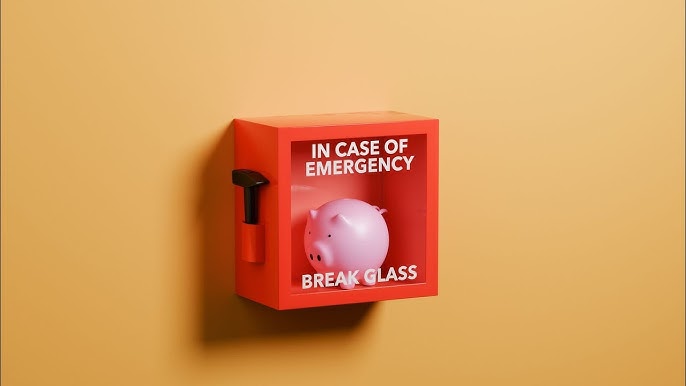
Start with an Emergency Fund Before Anything Else.
Before you dive into financial planning, the very first step you must take is to build a solid emergency fund.
Why?
Because life is unpredictable. An emergency fund gives you the financial cushion to deal with sudden shocks – be it job loss, a medical emergency or an unplanned expense – without draining your financial stability. Even the best financial plan can collapse without a safety net.
What exactly is an Emergency Fund?
An emergency fund is a cash reserve you keep aside only for emergencies.
# It is not to be touched for your routine monthly expenses or lifestyle choices.
# It acts as a safety net that keeps you afloat when an unexpected event strikes.
How Much Should You Keep Aside?
To understand this better, let’s take an example.
Case Study: Ravi
Age : 32
Family: Wife & 3-year-old kid
Location: Staying on rent at Vashi.
Job: Private company employee
Monthly Take Home Salary: ₹60,000
His monthly expenses:
# Food & Household Essentials – ₹18000
# Utilities( mobile, electricity, wi fi) – 5000
# Rent : ₹20,000
# Personal Expenses: ₹10,000
# Savings : ₹7,000
Now, imagine Ravi suddenly loses his job.
# His non-negotiable needs ( Food, Household Essentials, Utilities, Rent) = ₹43,000
# His wants ( movies, Zomato orders, shopping etc.) can be trimmed to ₹3000.
# Savings of ₹7,000 can be paused during the crisis.
So, His actual monthly survival expense = ₹46,000
The Thumb Rule :
Your emergency fund should cover 3X to 6X. Your monthly expenses:
- 3 months = ₹46,000×3 = ₹1,38,000
- 6 months = ₹46,000×6 = ₹2,76,000
Which Multiple you choose depends on your circumstances:
- If Ravi’s wife was also earning, his parents could provide support, and he was confident of finding a new job quickly— 3X is sufficient.
- For a businessman or someone with uncertain cash flows — 6X or more is safer.
Insurance: Another Form Of Emergency Fund.
It’s also worth noting that life insurance and health insurance work in the same spirit as an emergency fund. They protect you financially during critical situations, reducing the burden on your savings.
But remember, you can’t take insurance for every other uncertainty. That’s exactly where your emergency fund steps in – covering all those gaps that insurance cannot.
Final word
Building your emergency fund should be your top priority. The sooner you reach your target, the more peace of mind you will enjoy.
And remember – once you’ve built it, don’t let temptations like Amazon sales or the latest gadgets eat into it. Your emergency fund is your financial lifeline. Guard it carefully.
Where to Park Your Emergency Fund?
A practical thumb rule often followed is 10:20:70
- 10% in cash or savings account
- 20% in Fixed Deposit (FD)
- 70% in Liquid Mutual Funds
I personally suggest keeping 5-10% in Cash. In some situations ( like medical emergencies, ATM down, no-network area) cash is the only option that truly helps.
A savings account is also useful for quick access, though returns are minimal.
You can also think of Sweep-in or Auto-Sweep FD. Money above a set limit in your Savings account, automatically moves into a FD and earns FD- like interest. When you need the money, it automatically sweeps back into your Savings account.
Liquid mutual funds, on the other hand, offer slightly better returns than FDs and provide high liquidity. They don’t have entry or exit loads, and your money is credited back to your bank account within 24 hours. They are generally considered safe for parking in emergency funds.
FDs are also reliable, but premature withdrawals attract penalties. For those not comfortable with online transactions, parking up to 50% in local bank FD can be a practical choice for immediate needs.
Should You Pay Off Debt Before Building an Emergency Fund?
This is a common dillema. The answer is balance. Both are important.
- Paying off debt reduces your interest burden.
- Building an emergency fund provides financial security.
The ideal approach is to start small – save gradually for your emergency fund while making consistent efforts to pay down debt. Once your emergency fund target is achieved, shift your full focus towards closing outstanding Loans.
Final Thoughts
An emergency fund is not just money set aside – it’s your financial shield. It :
- Protects your long-term financial goals.
- Saves you from falling into the trap of high-interest Loans.
- Reduces stress during uncertain times.
- Gives you the confidence to handle setbacks, like a job loss, with clarity and peace of mind.
Protects your long-term financial goals.
Saves you from falling into the trap of high-interest Loans.
Reduces stress during uncertain times.
Gives you the confidence to handle setbacks, like a job loss, with clarity and peace of mind.
Remember, financial planning doesn’t begin with investments — it begins with security. And that security comes from having a strong emergency fund. Build it. Protect it. And, let it be the foundation on which the rest of your financial journey stands firm.
That’s all for today’s post. Since we touched upon terms like liquid fund, entry load, exit load, FDs, etc, I’ll talk about that in future blogs. Stay tuned – more insights coming your way soon!
Disclaimer: The information provided in this blog is for educational and informational purposes only and should not be construed as financial advice. Readers are encouraged to consult a qualified financial advisor before making any financial decisions. All views expressed are personal.