People-to-People Direct Benefit Transfer [P2P DBT] Model (Copyright (c) 2026 Niranjan Saha) : A New Approach to Poverty Eradication
Author: Niranjan Saha
Objective: Highlighting Opportunities for Poverty Eradication [HOPE]
Contact Information: info@niranjansaha.com
Mobile number: +91-9833009498
Date of submission: NA
B. Abstract
HOPE through the P2P DBT Model
H – Highlighting
O – Opportunities
P – for Poverty
E – Eradication
Simple model, powerful impact
The concept is simple. There will be an App that enables money transfer to the most vulnerable section of the society. This transfer is from People -To -People.
We expect the Government of India to be involved totally in this process of identifying the most vulnerable section. Government participation will enhance trust, credibility, and public confidence. It also ensures transparency, fairness, and legitimacy. Once the target group is identified from the grassroots and each beneficiary is certified by the Government, we can work on making an App that can work on a concept of Google
Map wherein all the beneficiaries would be mapped individually with complete Profile (name, age, occupation, family size, income, poverty status, landless or marginal farmers etc). The government can invite and encourage technology leaders from the Fintech and Software sector to develop the Super App through which a donor identifies the beneficiary, chooses the contribution amount, selects the payment method, and then submit it for the direct transfer on a real time basis.
There could be so many things that can feature the App, say for example, minimum transfer could be as low as ₹10 and the process would be as easy as Paytm or Google Pay or say we can set a ‘Cap’ on the transfer limit to each account for may be ₹5000 or ₹6000 per month.
Human psychology is, once we can directly and instantly help a person that we can identify and choose from the App or maybe, even talk to the person, we would love to help and feel the joy of giving. The existing support system to help reduce poverty and inequality is not adequate. So, it would be a complementary and a parallel approach to the existing welfare programs of government and NGOs for addressing the issue.
E. The Proposed Economic Model (P2P DBT)
—- A Bridge to HOPE
The Model is based on a well-defined structure of government and private sectors with a goal to reach the entire population of the country be it a giver or donor, receivers, or beneficiaries or even the influencers.
The structure functions through a specific process where the donor must identify a beneficiary, then choose a contribution amount, select a payment method, and finally submit the amount.

There are certain features, say for example, the beneficiary bank account cannot receive beyond a fixed amount of ₹6000 per month.
The App would be designed as follows:
Donor Registration.
The donor logs in via Phone number/ email/Aadhaar
Identifies individuals: State>District>Village. AI can suggest based on Poverty Heatmaps.
AI Powered Beneficiary Search
The App fetches verified needy individuals from government backed, regularly updated data base
The technology -based App matches donor with beneficiaries based on location, needs, and urgency.
In this Model, poverty Heatmaps can play a crucial role in identifying the right beneficiaries by providing a data- driven, visual representation of poverty concentration.
Heatmap Generation (Visualization of Poverty Pockets).
Use AI & Geospatial Mapping tools (Google Earth Engine, GIS, Tableau, or Python libraries like Folium).
Create colour-coded maps where:
Darker areas = High poverty intensity o Lighter areas= Lower poverty levels
Beneficiary Identification
Filter out households based on predefined criteria (income level, unemployment, social vulnerability).
Direct Benefit Transfer Execution
For a seamless payment system, we must follow certain steps:
Aadhaar bank linkage (India specific) or equivalent National ID – linkage in other countries to authenticate beneficiaries.
Mobile number linkage with bank accounts for OTP- based verification.
*Direct Bank Transfer integration for instant fund transfer.
UPI (Unified Payments Interface)/ Digital Wallets for real time transaction.
Interoperability with existing Payment Systems (e.g., SWIFT RTGS NEFT, IMPS).
Offline Payment Support via QR codes, USSD, or SMS based transactions.
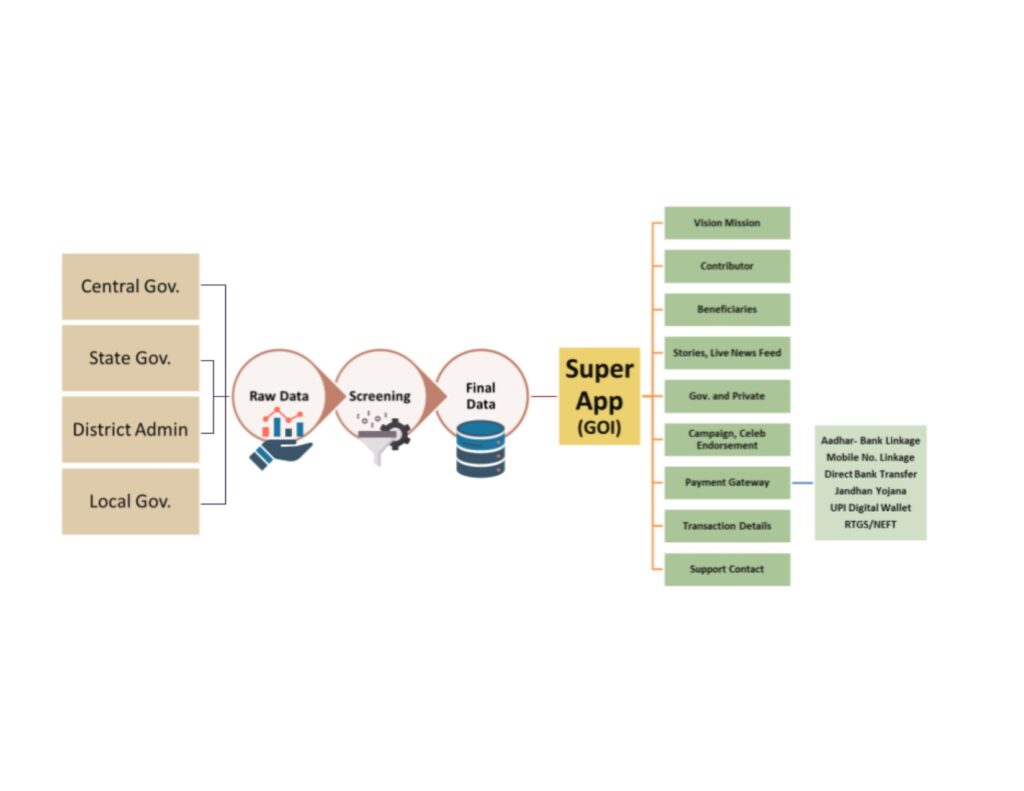
Flow Chart: P2P DBT Economic Model
Note: An article on The P2P DBT Model is featured on Julius Baer Foundation Knowledge Hub.
Now, the model has been formally copyrighted.
For those who wish to study in full detail, the complete version is available at the link below.
👇